
Faculty Spotlight: Karen Koziol
- Spotlight on Mercy’s Employees
- Karen Koziol
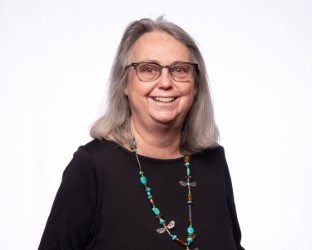
Karen Koziol
Director of Clinical Simulation, School of Nursing
When nursing students at Mercy step into the simulation lab, they’re stepping into something Karen Koziol helped build — sometimes literally. As Director of Clinical Simulation, she designs the clinical scenarios, selects the equipment and creates the conditions where students can practice high-stakes skills before they ever set foot in a real patient-care setting. The result is a learning environment that’s rigorous, realistic and grounded in decades of firsthand clinical experience.
That experience runs deep. Koziol spent more than three decades as a bedside nurse, primarily in the NICU, before transitioning into nursing education. She brings that clinical foundation into everything she does at Mercy — from teaching Nursing Informatics, Community Health Nursing and Nursing Leadership and Management, to advising students, coordinating clinical placements and developing the policies and procedures that keep the simulation program running at a high standard.
What students get in Karen Koziol is someone who has seen what nursing truly demands — and has built the tools to help them meet it.
Koziol’s path to nursing wasn’t exactly planned — and neither was her path to Mercy. But as she’ll tell you, some of the best things in life are unplanned. Read on for her story, including what four decades in the NICU taught her, how she built a simulation lab with her own hands and about a promise she made to a Sister of Mercy in first grade that she’s spent a lifetime keeping.
Q&A
What drew you to the field you work in and what led you to work in higher education?
When I graduated high school, I wasn’t quite sure what I wanted to do. I received a full scholarship to complete a nursing program and decided to give it a try, even though I didn’t know any nurses at the time, or even if I’d even like it. While completing the required 12 credits each semester, I took on extra coursework — up to 21 credits — in English and history, as a backup plan in case I decided to become a teacher.
During nursing school, something clicked. I discovered that I truly enjoyed nursing and realized that I was good at it. In hindsight, those extra courses were not wasted — they served me well later when I transitioned into nursing education, especially for grading and academic writing.
What does working at Mercy mean to you?
Working at Mercy means a great deal to me. I first came here as a student in 2005 for my master’s in nursing education, graduated in 2007, and was hired immediately afterward. I’ve never really left. I feel like a small but happy part of the Mercy family.
What’s the most rewarding or most challenging part of your role that most people don’t realize?
Many people don’t realize that I helped build the nursing simulation lab. It was a hands-on process — imagining the space, selecting equipment, securing funding and even installing items myself late at night. I also contributed to the simulation labs at the Bronx campus.
In addition, I spent 10 years in academic advising and worked in clinical placements, which gave me a strong understanding of both student needs and the challenges faced by our clinical placement team.
What accomplishment are you most proud of in your professional career?
First and foremost, I’m proud of my work as a bedside nurse from 1974 to 2010, primarily in the NICU. I had the privilege of helping save hundreds of lives.
One especially meaningful moment was teaching a student who had (20 years ago) once been my neonatal patient — I had held her the day she was born, and years later, she graduated as a Mercy Nurse. I still smile when I think about it.
Another was being invited to the high school graduation of a former 25-week preemie I had cared for — once so fragile – but off to a safe and strong start, she grew into a strong and capable young woman was accepted to both Harvard and Yale (and chose Yale). Her mother, inspired by the nursing care her child received, became a nurse and later a nurse practitioner — something I’ve always been proud to have played a small part in, and a reminder that the small things we do each day can have a lasting impact. Today, she's impacting patients and moving it forward.
At Mercy, I’m also very proud of the simulation labs and the way they support hands-on learning for our students.
What upcoming projects, research, or initiatives are you excited about?
We’ve recently implemented SimView on the Dobbs Ferry campus, and I’m looking forward to working with that system. We’re also beginning to explore virtual reality simulation. While I’m a bit traditional, I’m excited about moving into the future with these new modalities.
Share a favorite Mercy University memory.
When I was in first grade (1960s) in New York City, one of my teachers — a Sister of Mercy — told me, “When you grow up, be sure to go to Mercy College.” I promised her I would.
So every time I pull onto campus, I smile a little, remembering that promise — and realizing I kept it.
What’s the most important piece of advice you’d give to a freshman student about beginning their first day at Mercy University?
Make sure to moisturize and drink plenty of water. Everything else, you’ll figure out.
Do you have any hidden talents your colleagues at Mercy might be surprised to learn about?
I enjoy working behind the scenes and helping things come together. I also seem to have a knack for writing strong letters of recommendation that help students secure scholarships, internships and awards.
If you were to pursue a different career path outside of education, which field could you see yourself working in, and why?
Before education, I had a long career as a bedside nurse. Looking ahead, I could see myself focusing more on writing — perhaps beyond academic work and into other forms of writing.
If your life was a movie, what would the opening credits song be?
"I Will Survive" by Gloria Gaynor.
As a nurse in the 1970s, we actually used songs like this to time CPR. While “Stayin’ Alive” is the most well-known, “I Will Survive” was one we often used in the neonatal ICU — it has a rhythm close to the recommended compression rate.
What topic could you give a 20-minute presentation on, with no preparation whatsoever?
Neonatal resuscitation, crocheting a granny square afghan or planning a cross-country road trip with a spouse and a dog.
Looking ahead, what are you most looking forward to and why?
I’m looking forward to continuing to grow with new simulation technologies, especially VR, and seeing how they enhance student learning and confidence in clinical practice.
What are the key responsibilities of your department?
Our department focuses on simulation-based education — creating realistic clinical scenarios that allow students to practice skills, develop critical thinking and build confidence in a safe learning environment.
What does a typical day look like for your team?
A typical day involves preparing simulation scenarios, maintaining equipment, supporting faculty and students during lab sessions and troubleshooting both clinical and technical challenges in real time.
What are the most common questions your department receives?
Students often ask about how to prepare for simulation, what to expect during scenarios and how simulations are evaluated.
What’s one thing you wish more people knew about your department?
Simulation is not just “practice” — it’s a carefully designed educational experience grounded in clinical standards and learning theory.
Who should faculty, staff, or students contact for assistance?
They should reach out directly to the simulation team, and we’ll guide them to the appropriate resource or support.
What’s one helpful tip from your area of expertise that you’d offer to fellow members of the Mercy community?
Practice skills consistently in a low-stress environment. Confidence in clinical settings comes from repetition and preparation.
Do you have a fun fact or little-known insight about your office or department?
Many of the simulation lab setups were built from the ground up — sometimes quite literally — by faculty who envisioned what students would need and made it happen.