
Mercy University Hosts Women’s Empowerment Summit: The Power of Our Stories— Women Shaping Tomorrow’s World
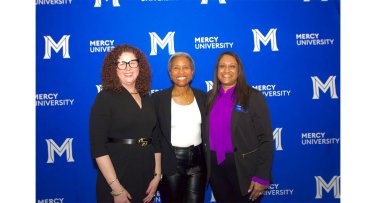
Provost and Senior Vice President for Academic Affairs Dr. Kristin Curry Greenwood, Emmy Award-winning filmmaker and journalist Luchina Fisher, keynote speaker, and Dr. Roseanne Vallice Levy, associate provost for faculty development and teaching excellence at the Women's Empowerment Summit.
On Friday, February 27, Mercy University’s Westchester Campus rotunda filled with students, faculty, staff and community partners for the 10th Annual Women’s Empowerment Summit: The Power of Our Stories — Women Shaping Tomorrow’s World. The event brought together voices from across the Mercy community and beyond, anchored by a keynote from Emmy Award-winning filmmaker and journalist Luchina Fisher, and a panel of women leaders whose work spans public health, STEM education, mental health and international advocacy.
This year’s summit was co-presented with the United Nations Association (UNA-USA), Westchester Chapter — a partnership that goes back over 15 years through Mercy’s Model U.N. program.
“We have loved partnering with Mercy and have been doing so for years. We decided that this summit would be the perfect kickoff to International Women’s Day, which is on March 8, and Women’s History Month, which starts on Sunday,” said Marcia M. Brewster, president of the UNA-USA Westchester Chapter.
Dr. Roseanne Vallice Levy, associate provost for faculty development and teaching excellence, opened the event by tracing Mercy’s origins. “Seventy-five years ago, a group of trailblazing women, the Sisters of Mercy, defied conventions to establish this amazing institution of higher education,” Levy shared. “They empowered generations of women to push past boundaries and achieve their potential.”
In a video message, President Susan L. Parish connected that legacy directly to what’s happening on campus today. She said: “Our faculty and staff work daily to empower, inspire and foster education for all, just as the Sisters of Mercy envisioned. Today’s summit reflects our shared commitment to equity, inclusion and the power of selective engagement, values that resonate deeply with our mission and with the work of the United Nations.”
Provost and Senior Vice President for Academic Affairs Dr. Kristin Curry Greenwood expanded on what that commitment looks like in practice. “Mercy University has long believed in the transformational power of women’s education. Women’s colleges, women-centered spaces, have historically been the incubators of leadership, places where women can imagine themselves not only participating in society but also as the architects of their future.” Greenwood added, “That legacy continues here, in every classroom, every lab, every studio and every conversation that shapes our students’ sense of possibility.”
Keynote: Dreams Don’t Expire
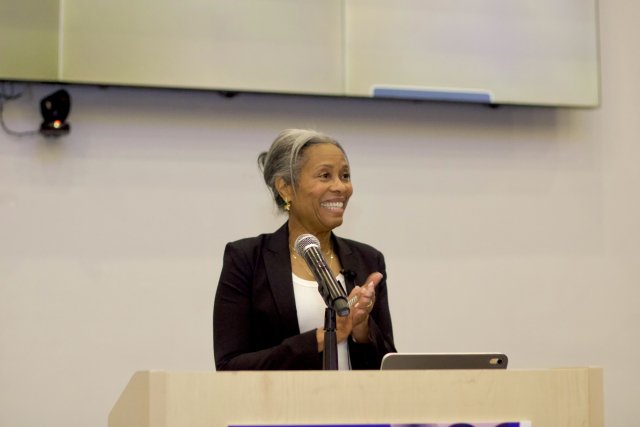
Luchina Fisher
Anika Charles, a Mercy master’s student in the Mental Health Counseling program, introduced the keynote speaker with a line that set the tone for everything that followed. “It is especially meaningful to me to stand here today and introduce a woman whose work demonstrates the profound connection between storytelling, advocacy and human dignity. The stories we tell shape how we see one another and how we care for one another. Our keynote speaker embodies that power in extraordinary ways,” she said
Luchina Fisher is an Emmy Award-winning filmmaker, journalist and educator, whose documentaries have won national recognition. She opened by asking who in the room considered themselves a late bloomer. She asked if anyone felt that they bloomed too early and might not have a chance to bloom again.
“If there’s one thing that I want you to leave with here today it’s this: dreams do not expire. Let me say that again: There is no expiration date that is stamped on your potential. And yet, especially for women, we’ve been sold this idea that there is,” she said. Fisher continued, “You know that there’s this golden window that if you haven’t ‘made it’ by 35, or don’t have it all figured out by 40, if you’re not at the top of your game by 50, well, you missed it. Game over, right? I’m here to tell you that’s wrong. And it’s not just wrong, it’s dangerous. We’re going to talk about the myth of the ‘expiration date.’”
Fisher didn’t make that argument abstractly. She made her first feature film, at 53. It’s a documentary about a Black transgender activist in her 70s, Mama Gloria, that won festival awards, aired on PBS and earned a GLAAD Media Award nomination.
“I suddenly thought back to all the years that I thought were detours, but they weren’t detours,” she explained. “They were training. The patience. The resilience. The emotional intelligence. The grit. I wasn’t late, I was ready. And then three years later I won the Emmy for Short Form Program.”
Fisher also spoke to the women who’d hit every goal they set for themselves and still felt like something was missing, and to the younger women still figuring out where they’re headed.
“Because here’s the beautiful irony for all of us: at 45, 50, 60 even 70, you are far more equipped to fulfill your little girl dreams than you were at 25 years old. Why? Listen up all my 20- and 30-somethings because here’s what you have to look forward to: Perspective. Your network. Experience. Emotional depth. And a lot less interest in pleasing everyone. That’s powerful.”
Her advice to the students: be your own green light. Keep your day job if you need to. Find your people. Stay in the work, even during the fallow periods — because those periods are doing something, too.
The Panel: Barriers, Persistence, Allies and Change
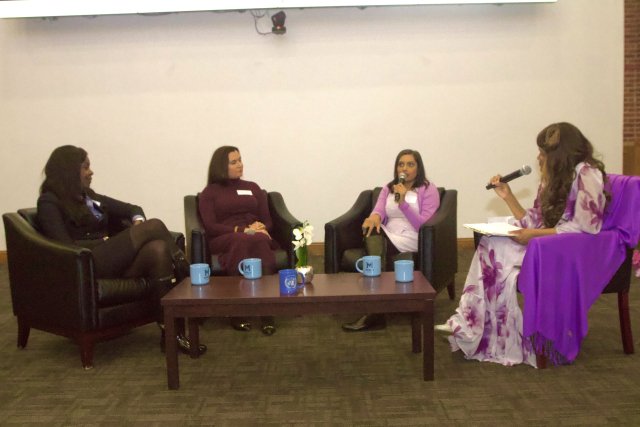
From left to right: Judith M. Watson, Dr. Amanda M. Gunning, Dr. Melissa Ramdas and C. Michele Shivers
The afternoon panel, moderated by C. Michele Shivers of the UNA-USA Westchester Chapter, brought together four women whose diverse paths converged on a shared vision of empowerment: Hawa Taylor-Kamara Diallo, president and executive director of the I.B. Taylor-Kamara Foundation and former chief of the Civil Society Unit at the U.N. Department of Global Communications (who joined via Zoom); Dr. Amanda M. Gunning, professor of Science Education and co-founder of Mercy’s Center for STEM Education; Dr. Melissa Ramdas, assistant professor in Mercy’s Counseling Department and licensed mental health counselor; and Judith M. Watson, chief executive officer of Westchester Community Health and Mercy honorary doctorate recipient.
Shivers framed the conversation: "Stories change policy, they influence culture, they transform institutions and they inspire the next generation."
The panelists discussed some of the barriers they have faced as women and as professionals and the importance of persistence, allyship and community to make an impact.
Gunning shared how she and a colleague created Mercy's Center for STEM Education by refusing to take no for an answer. "We just kept asking different people until we found advocates in the administration. This year's our 10th year—it's exciting!"
Diallo, reflecting on nearly four decades at the U.N., offered a sharper perspective: "The change we're all looking for, that empowerment, is within, and it's at the local level. It's not going to be found at the United Nations or Davos. It's going to be found with the people." She also stressed the importance of having men be a part of the empowerment conversations.
On male allyship, Ramdas added: “We don’t want them to see the flyer and think, ‘Oh, it’s about women so I’m not included.’ We never said you weren’t included, you just thought that way. Because the messaging they got when they were younger became the word ‘Women’ means you’re not invited.”
Watson agreed, and reminded the room that change, even when it’s slow, is real. “Sometimes things take time, but we just have to keep plugging away at it, right? Perhaps not as rapidly as we’d all like but there is change. So, stay the course and take advantage of every opportunity that you have.”
What the Room Carried Out
Amanee Pettway, a Mercy adjunct professor in Sociology and Counseling, attended the summit with the hoped of feeling uplifted and that is exactly what she found.
“And what we talked about today very relatable. And I really needed this. This helped heal my heart in a little way.”
That line captured something true about what the Women’s Summit does so well: It just puts people in a room together and lets them hear what’s possible.
Dreams don’t expire. The timeline is a myth. And the women who filled the Rotunda on February 27 left with a little more certainty of both.