Mercy University Celebrates Faculty Excellence at Annual Recognition Ceremony and Poster Session
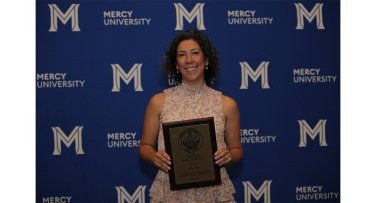
Teaching Excellence Award recipient Justine Matias, instructor, English
On Monday, May 18, the Mercy community gathered in the Rotunda on the Westchester Campus to honor the scholars, mentors and educators who make up the heart of the institution. The annual Faculty Recognition Ceremony brought together faculty, staff and university leadership for an afternoon of celebration, recognizing retirements, promotions and research faculty carry into their classrooms every day.
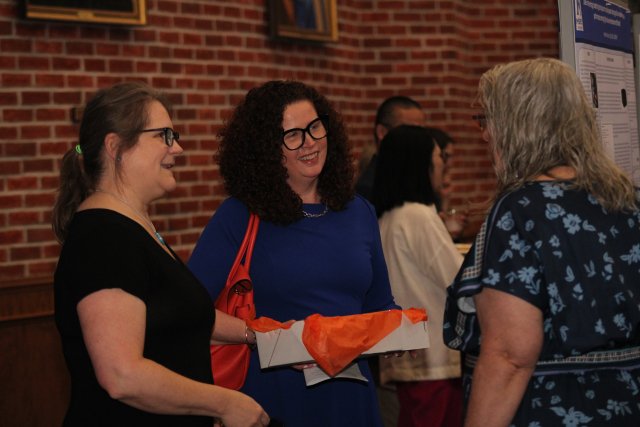
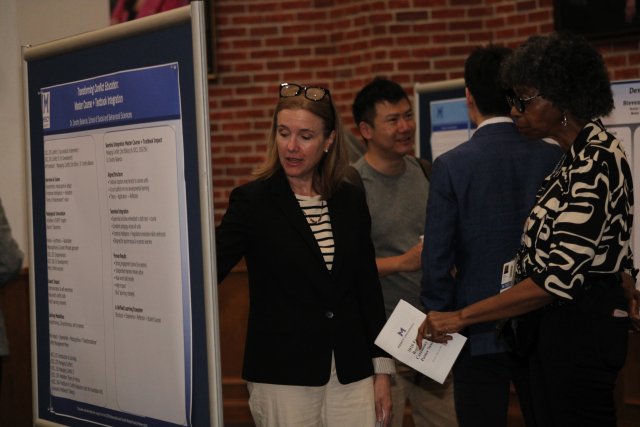
Before the ceremony began, the Rotunda filled with conversation. Large, colorful research posters lined the space, each one a window into the work Mercy faculty have been doing all year. Attendees moved among the displays, stopping to talk with presenters about topics that included AI integration, synthesis of novel photocaged biomedicals, faculty wellness, global service learning, transforming conflict education and telehealth risk assessment simulation training.
The breadth of the scholarship on display was striking.
“The faculty are at the heart of how we advance our student success,” said Mercy’s President Susan L. Parish, PhD, MSW, who spent time at the poster session speaking with faculty about their research. “Learning is the core of everything we do, and I’m excited about today because we’re celebrating faculty excellence.” Parish continued, “These posters are so impressive. Faculty are sharing their scholarship, which they take back into the classroom to advance their students.”
Breaking Free from the “Tyranny of the Textbook”
One of the most visited displays was “Collaboration and Liberation: An AOER Faculty/Library Creative Partnership,” presented by Julie Goldberg, assistant professor, Libraries, along with co-creators Yu-Hung Lin, assistant professor, Libraries, and Jacqueline Fisher, assistant professor, Psychology. AOER refers to Affordable Open Educational Resources.
The research centered on LibGuide, a structured, visually designed digital resource built entirely from free resources, including those that the Mercy Libraries already own. No textbook required. No cost to students.
“Textbooks are extremely expensive, and many Mercy students struggle to pay for them,” said Goldberg. “Research has found that students do not buy the textbook, which leads to poor grade-point averages and other negative academic outcomes. OER — open educational resources — is supposed to address that equity problem. Our idea, making this AOER using resources that the library pays for that are free to students, is a way to bridge that gap between published materials and the OER available on the web.”
The LibGuide mirrors the structure of a textbook chapter, laying out key ideas visually, organizing peer-reviewed articles, videos and reference sources by unit. It includes a flexibility no published textbook can offer: If a professor drops a unit or adds a new one, the guide updates instantly. Students were also invited to contribute sources they found during group projects, making the resource a living collaboration between faculty, librarians and students.
“This liberates professors from the tyranny of the textbook,” Goldberg noted. Textbooks that can go out of date, carry bias or lock faculty into teaching someone else’s sequence. AOER, Goldberg explained, “Gives professors the freedom to teach the units they want to teach in the order they want to teach it, with the materials they want to teach.”
Designing AI that Reaches Every Learner
Barbara Hastie, adjunct faculty in Educational Leadership, presented “Designing Inclusive, Accessible AI into Job-Embedded Professional Learning,” developed in partnership with Nona Ullman, Founder and CEO of LessonLoop, one of only two firms nationally certified by Digital Promise for prioritizing racial equity in AI design.
The research addressed a gap that sits at the intersection of two urgent conversations in education: how to use AI effectively in lesson planning, and how to ensure that AI doesn’t reproduce the biases already embedded in teaching materials. LessonLoop developed a bias-detection tool that runs lesson plans through a checker evaluating cultural inclusivity, language neutrality and accessibility, particularly for students with disabilities.
The team ran 50 tests, ten without the bias checker and ten after, across grades four and eight in four subjects.
“We were able to reduce bias by 69%,” said Ullman. This impressive statistic caused many of the people gathered to gasp in surprise, calling it “astonishing” and deeming the research “very, very important.”
The implications reach beyond K–12. The research has direct applications for higher education faculty who work with pre-service teachers, helping new educators design lessons that reach all learners from the start.
“I really think that this program will help new teachers get off on the right foot,” said Hastie. “They’re finding that if you can engage kids, they can learn more, but this is definitely not taught right now. The goal is how do we get new teachers up to speed faster.”
Putting Data Behind a National Conversation
Jeong Kim, associate professor of Criminal Justice, presented “Patterns and Disparities in Police Shootings: 2015–2021 Quantitative Analysis,” research with direct implications for police training, department policy and public understanding.
Kim explained that public perception is shaped heavily by social media and news coverage. That leads to the belief that police shootings are on the rise. Kim’s data tells a more complicated story.
“People think that we are having more police shootings, but actually statistics show that it’s steady,” Kim said. “It’s good news and bad news at the same time. The good news is we don’t have a higher number of police shootings. But the bad news is, even though we invest a lot of resources in police training and education, it’s still not getting better — it’s not going down.”
The research is intended to inform police departments and, ultimately, the public — grounding a conversation that often runs on emotion in evidence instead.
Celebrating Mercy’s Exceptional Faculty
Dr. Kristin Curry Greenwood, provost and senior vice president for Academic Affairs, opened the recognition ceremony with remarks that acknowledged both the achievements on display and the effort behind them, as well as the academic year overall.
“In the name of student success, we confronted an environment that required change — real change, and sometimes uncomfortable change,” Greenwood said. “And you met that challenge with courage, creativity and most of all, commitment to students with your heart.” She continued, “You adapted, you innovated, you stayed focused on what really matters most, our North Star: student success. I’m grateful for all that you have done and for all of you who have participated in this important work this year.”
Greenwood introduced Mercy’s President Parish, who spoke directly to the faculty about what their work means, not just to Mercy, but to the students who depend on them.
“You are the mentors who guide, you’re the scholars who advance knowledge, you’re the innovators who reimagine what’s possible,” Parish said. “And you are the advocates who ensure every student has the support they need to thrive. Your work is not just important. It’s foundational to who we are and to what Mercy does.”
The recognition ceremony that followed gave each school’s dean a moment to stand with their faculty, calling members to the stage, presenting a silver cup and sharing the accomplishments that brought them there. It was one part ceremony, one part tribute.
Among those recognized was Dr. Kathryn Ryans, who was recently promoted to Professor and is retiring after a distinguished career in physical therapy education. Dr. Ryans earned her M.S. from Mercy and her DPT from Temple University and has been practicing physical therapy in an outpatient orthopedic setting since 1995. Her scholarly contributions include co-authored peer-reviewed publications and presentations at national conferences focused on oncology rehabilitation and clinical education, work she balanced alongside sustained service in faculty governance, curriculum development and student mentorship.
“I’ve learned a lot at Mercy,” Ryans said. “Being a physical therapist has allowed me to bridge the gap between medical practice and teaching for my students who are going out to become physical therapists. I’m hoping to come back as an adjunct — I’m not leaving teaching completely.”
Faculty Awards Ceremony
Following the celebration of retirements and promotions, the ceremony turned to faculty awards, a separate honor recognizing outstanding contributions across teaching, scholarship and service. Each year these awards spotlight the faculty members whose work has gone above and beyond, chosen by students, their peers and academic leadership as exemplars of Mercy's commitment to excellence. (The list of faculty members who received awards is included below.)
A Closing Worth Carrying Forward
Provost Greenwood closed the afternoon with a quote that was well-chosen for the moment.
“Winston Churchill said, ‘Success is not final, failure is not fatal. It is the courage to continue that counts,’” she told the assembled faculty. “That courage is exactly what I have seen in our community this year, and I’m forever thankful for all the work we continue to do together.”
Faculty Accomplishments
School of Education, presented by Eric Martone, Dean, School of Education
- Nancy Heilbronner, PhD, Retirement
- Barbara Keckler, PhD, Retirement
- Matthijs Koopmans, EdD, Retirement
- Ilene Rothschild, EdD, Retirement
School of Health and Natural Sciences, presented by Nannette Hyland, Interim Dean, School of Health and Natural Sciences
- James Gurley, PT, DPT, Promotion to Associate Professor
- Ashley O'Rourke, CCC-SLP, EdD, Promotion to Associate Professor
- Shari Berkowitz, CCC-SLP, PhD, Retirement
- Ferdinand Esser, DC, Retirement
- Ruth Lyons Hansen, PT, DPT, PhD, Retirement
- Peter Minorsky, PhD, Retirement
- Kathryn Ryans, PT, DPT, Promotion to Professor; Retirement
School of Liberal Arts, presented by David Wang, Interim Dean, School of Liberal Arts
- K. Patrick Fazioli, PhD, Promotion to Professor
- Justin Kessler, MM, Promotion to Associate Professor
- Laura Proszak, PhD, Promotion to Associate Professor with Tenure
- Usman Rauf, PhD, Promotion to Associate Professor with Tenure
- Caitlin Wiesner, PhD, Promotion to Associate Professor
Libraries, presented by Moddie Breland, Dean, Libraries
- Susan Gaskin-Noel, MSLIS, Retirement
School of Nursing, presented by Nannette Hyland, Interim Dean, School of Nursing
- Miriam Ford, FNP-BC, PhD, Retirement
- Susan Moscou, FNP-BC, PMHNP-BC, MPH, PhD, Retirement
- Renu Varughese, RN, PhD, Retirement
School of Social and Behavioral Sciences, presented by Cynthia Walley, Interim Dean, School of Social and Behavioral Sciences
- Jeong L. Kim, PhD, Promotion to Professor
- Alberto Manzi, LMHC, PhD, Promotion to Professor
- Shakuntala (Melissa) Ramdas, LMHC, PhD, Promotion to Associate Professor
- Dorothy Balancio, PhD, Retirement
Academic Affairs, presented by Kristin Curry Greenwood, Provost and Senior Vice President for Academic Affairs
- Saul Fisher, PhD, Promotion to Professor
- Victor Petenkemani, MBA, Promotion to Associate Professor
- Cynthia Walley, PhD, Promotion to Professor
The Faculty Awards were presented by Amanda Bireline, Chair, Advisory Committee for Teaching and Learning.
The 2025 – 2026 Faculty Awards recipients are:
Teaching Excellence Award
- Full-Time Faculty: Robert Murray, PhD, Associate Professor, History (School of Liberal Arts)
- Part-Time Faculty: Justine Matias, MA, Instructor, English (School of Liberal Arts)
Faculty Fellow
- G. Lee Warren, PhD, Associate Professor, Chemistry (School of Health and Natural Sciences)
Online Teacher of the Year
- Sally-Ann Delvino, MA, Senior Instructor, Italian (School of Liberal Arts)
Outstanding Research Award
- Jack Simons, LPC, PhD, Associate Professor, School Counseling (School of Social and Behavioral Sciences)
ACUE Effective Teaching Practices
- Oren Abramowitz, CCC-SLP, PhD, Assistant Professor, Communication Disorders (School of Health and Natural Sciences)
- Saliha Bava, PhD, Professor, Marriage and Family Therapy (School of Social and Behavioral Sciences)
- Nancy Beverly, PhD, Associate Professor, Physics (School of Health and Natural Sciences)
- Marylu Dunn, PT, DPT, Visiting Assistant Professor, Physical Therapy (School of Health and Natural Sciences)
- Justin Kessler, MM, Assistant Professor, Music Production and Recording Arts (School of Liberal Arts)
- Tameka Hall Lee, FNP-BC, MS, Instructor, Nursing (School of Nursing)
- Olga Rabinovich, RN, MSN, Instructor, Nursing (School of Nursing)
- Lisa Schenkel, DVM, Assistant Professor, Health Sciences (School of Health and Natural Sciences)
- Lorraine Shikapwashya, DHSC, Assistant Professor, Health Sciences (School of Health and Natural Sciences)
- Jeanine Stancanelli, OTR/L, MBA, MPH, OTD, Associate Professor, Occupational Therapy (School of Health and Natural Sciences)
- Cynthia Walley, PhD, LPC, Associate Professor, School Counseling (School of Social and Behavioral Sciences)
Master of Pedagogy Degrees, honoris causa, presented by Susan Parish, President and Kristin Curry Greenwood, Provost and Senior Vice President for Academic Affairs
- Areiaf (Ariel) DiBlasio, Associate Director, University Advisement
- Leslie Heiner, MA, Senior Instructor, Art History, School of Liberal Arts
- Monelle Hylaris, Director, Enrollment Services
- Janet Lyons, MBA, EdD, Senior Lecturer, Organizational Leadership, School of Business
- Robert Mulroy, JD, Senior Instructor, Marriage & Family Therapy, School of Social and Behavioral Sciences
- Michael Perrota, MS, MFA, Associate Professor, Media Studies, School of Liberal Arts
- Michael Stafford, PhD, Senior Instructor, Seminars, School of Liberal Arts