
Mercy Professor Presents Groundbreaking Research on Human Judgment in the Age of AI
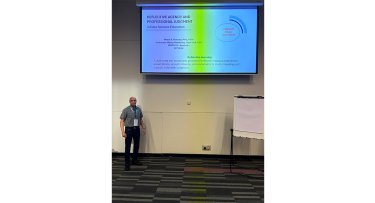
Dr. Rossi Hassad introduces new concept of "reflective agency" at premier international statistics education conference.
As artificial intelligence transforms how data is analyzed, a Mercy University professor is leading the conversation on why human judgment matters more than ever.
Dr. Rossi A. Hassad, professor in the School of Social and Behavioral Sciences, presented his peer-reviewed research at the Twelfth International Conference on Teaching Statistics (ICOTS-12), the world's premier statistics education conference, in Brisbane, Australia, this July. His paper, “Reflective Agency and Professional Judgment in Data Science Education," introduces an original concept that could reshape how we prepare students for data-intensive careers.
"The session was well attended and generated tremendous interest and many questions," Dr. Hassad said of his presentation.
Dr. Hassad's research introduces the concept of “reflective agency,” the ability to recognize when uncertainty, ambiguity, or ethical concerns demand deeper investigation, and to translate that reasoning into sound professional judgment. The concept emerged from an international study he conducted through Canterbury Christ Church University in the United Kingdom.
The study found that educators who engage in reflective teaching practices are motivated primarily by internal values rather than external pressures. Factors like comfort with reflective strategies, alignment with educational philosophy, professional relevance, available resources and curricular flexibility all contributed to reflective engagement, but intrinsic motivation proved more influential than institutional conditions. With further validation, the concept of reflective agency could inform how educators assess student learning and support professional development, helping future data scientists recognize and navigate uncertainty in their work.
"Much of the statistical modeling, programming, and algorithmic work we have historically done can now be performed more efficiently using AI (artificial intelligence) tools, and in some cases, with greater technical precision," Hassad explained. "As educators, our focus must shift to more meaning-making and professional and interpretive judgment, preparing learners to question AI output rather than accept its perceived authority."
Dr. Hassad emphasized the real-world stakes: "AI, big data, and complex algorithms can easily produce spurious correlations and other misleading findings. In high-stakes fields, especially healthcare, where lives are on the line, human judgment has never been more important."
His presentation represents the culmination of nearly a decade of research at Canterbury Christ Church University's Salomons Institute for Applied Psychology. Dr. Hassad's paper will be published in the official ICOTS-12 conference proceedings.
Dr. Hassad acknowledged Mercy University for its continued support of his research and for enabling his participation in this important international conference.
Dr. Hassad is a chartered statistician of the Royal Statistical Society (UK) and a fellow of the American College of Epidemiology. He also serves on the Accreditation Committee of the American Statistical Association, contributing to his longstanding work in statistics through teaching, applied research, curriculum development and professional service.