
Maverick Magazine Summer 2026: Thinking Under Pressure
- News & Events
- News
- Maverick Magazine Summer 2026: Thinking Under Pressure

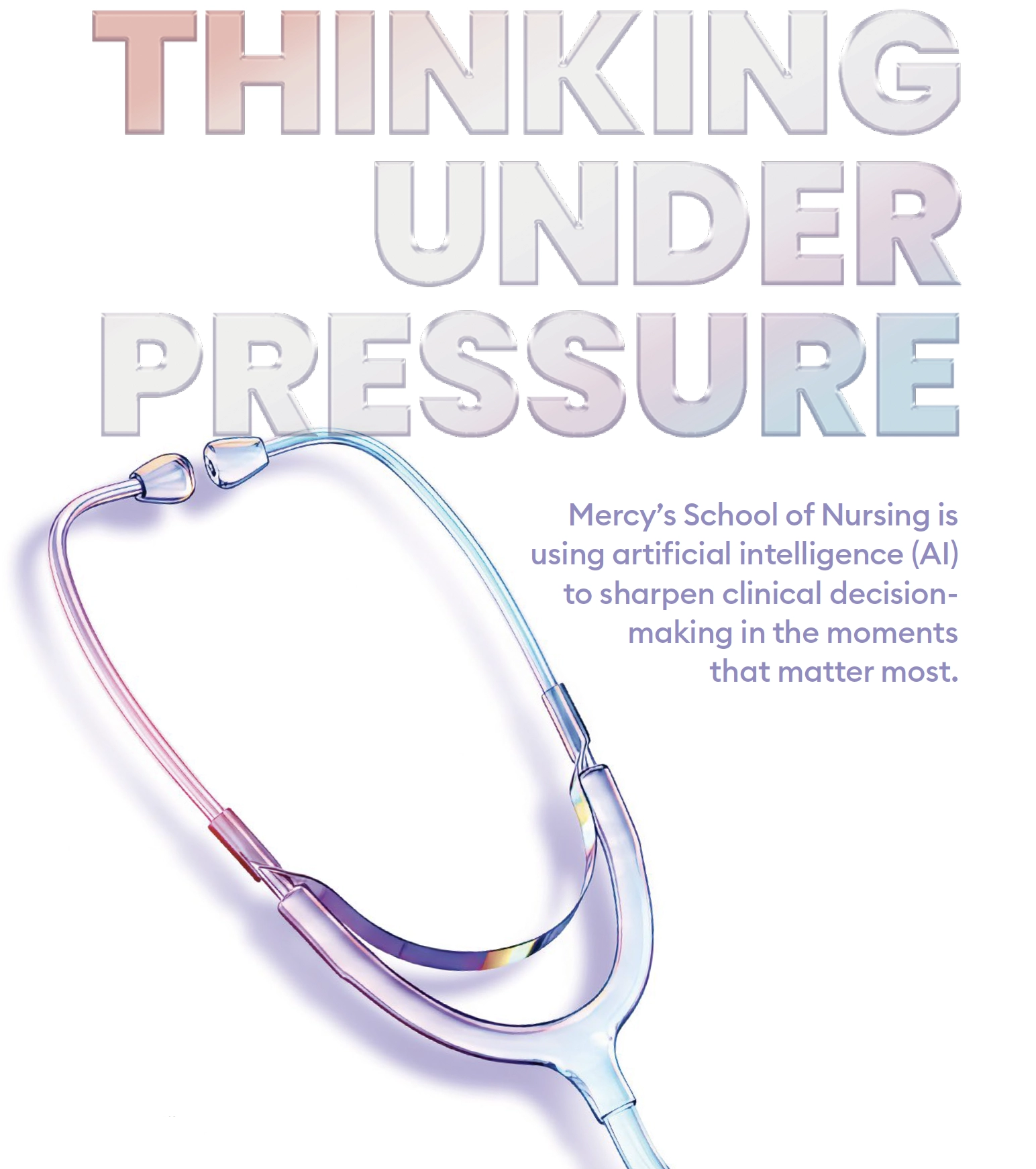
On a sunny Tuesday in April, students in Mercy University’s School of Nursing participated in a routine clinical simulation designed to prepare them for the fast-moving, often unpredictable reality of patient care. Faculty and staff were on hand, including Marvin Sanon, director of Simulation Operations and Karen Koziol, director of Clinical Simulation, Westchester Campus, School of Nursing. But this time, there was an additional presence in the room — quietly listening in. Kabilah, an AI-powered platform designed to support nursing communication and clinical decision-making, had joined the exercise.
As healthcare evolves, so does the way future nurses are trained. At Mercy University, tools like Kabilah are helping strengthen clinical decision-making, giving students added support in moments when clear thinking can make all the difference.
Borne out of a desire to reduce errors during hospital shift changes and nursing handoffs, Kabilah was designed specifically for the realities of nursing workflows. In an environment where nurses are working longer hours and managing increasingly complex patient needs, even small gaps in communication can have serious consequences.
“Nurses are working way more hours these days — more shifts and doubles,” said Sanon. “We’re trying, as all hospitals are around the world, to become high-reliability organizations.” In healthcare, high-reliability organizations focus on reducing errors, improving communication and strengthening patient safety.
During the simulation, as one student delivered a patient report and another received it, the platform listened in the background, capturing the exchange in real time. Within moments, it generated a structured report, surfacing key details and prompting deeper analysis during the debrief.
Instead of simply recalling information, students were asked to interpret it — questioning, for example, whether a patient’s low blood pressure was tied to medication or medical history.
“This isn’t about replacing clinical judgment,” Sanon said. “It’s about supporting it — giving students another layer of awareness so they can make better decisions.”
“It takes our reports to the next level,” said Koziol, who brings more than 50 years of experience as a registered nurse. “Seeing the technology change and grow has been an amazing journey.”
A Mercy graduate, Koziol began her career at Nyack Hospital and went on to work in the neonatal ICU at St. Vincent’s Hospital in Manhattan before returning full-time to Mercy in 2010.
When the traditional Nursing program was created in 2015, she served as the inaugural simulation specialist. “In the early days, the simulation team was just me. Now, as the nursing program has grown to include traditional, accelerated and weekend accelerated BSN tracks at Mercy University’s School of Nursing, the simulation team has expanded across two campuses, employs several staff members and is overseen by Marvin Sanon.”
What started as a makeshift lab in Mercy Hall has since grown into a cornerstone of the School of Nursing’s approach to hands-on learning. Today, simulation labs allow students to experience high-stakes clinical scenarios — such as diabetic emergencies, postpartum hemorrhages and asthma attacks — that they may not encounter during traditional clinical rotations.
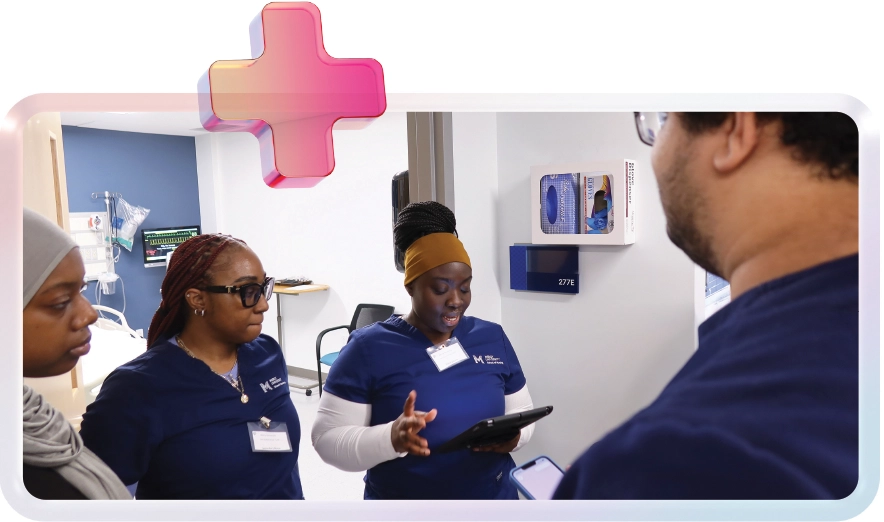
“We use simulation in a lot of different ways,” Koziol said. “It gives students the chance to practice, to make mistakes and to learn from them — without putting anyone at risk. And it builds confidence for when they step into the real world.”
For Koziol, the difference from her own training is profound. “When I was a nursing student, simulation didn’t exist,” she said. “We had to practice on real patients.” Now, that environment continues to evolve.
As simulation becomes more advanced, faculty are looking beyond what students do in a scenario to better understand how they think and communicate under pressure. That’s where Kabilah is beginning to play a role.
“In one of our scenarios, we had multiple students working together to manage a patient in crisis,” Sanon said. “Kabilah was listening the entire time — capturing everything.”
According to Sanon, the platform also revealed moments that might have been missed in real time. In one case, it identified a prolonged stretch — nearly 90 seconds — where no one was communicating, highlighting how easily critical time can slip by in high-pressure situations.
“It’s really analyzing everything,” Sanon said, giving faculty a much deeper understanding of how students perform under pressure. “We’ve been really impressed with it.”
For Mercy’s faculty, that level of insight is key. The goal is not just to expose students to clinical scenarios, but to reinforce critical thinking in real time.
“It’s easy to read a textbook and think you’ve retained the information,” Sanon said. “It’s different when you’re in the room and everything is happening at once.”
For Koziol, embracing that evolution is essential. “It doesn’t replace nursing — it aids it,” she said. “There is nothing that compares to hands-on clinical experience, but this prepares students for what they’ll encounter. They’re already using this technology in hospitals across New York City, so it gives our students a real advantage.”
That mindset extends beyond AI. Mercy continues to invest in emerging tools, including virtual reality platforms like SimX, which will allow students to participate in immersive clinical simulations across campuses and even remotely — an approach that gained traction across the industry during the COVID-19 pandemic.
“Our mission is to be on the forefront of technology,” Sanon said. It’s a mission rooted not just in innovation, but in impact. “Excellence at its best,” he added. “Mercy cares about innovation. Mercy cares about leading the next generation.”