
Maverick Magazine Summer 2026: The Power of Conflict


The Power of Conflict
Equipping students to navigate complexity and lead with purpose.
As professional environments grow more complex, the ability to navigate conflict has become essential across industries. From healthcare and education to business and public service, success increasingly depends on communication, emotional intelligence and the ability to work through differences. At Mercy University, a new Conflict Studies minor is designed to meet that moment.
Developed within the School of Social and Behavioral Sciences, the interdisciplinary minor brings together decades of coursework focused on conflict resolution, mediation and collaborative problem-solving. Open to students across all majors, it reflects
a growing recognition that these skills are not optional. They are foundational to how future professionals will lead, collaborate and make decisions.
“This minor grew out of conversations across the University about what students truly need to succeed,” said Dr. Cynthia Walley, interim dean of the School of Social and Behavioral Sciences. “No matter the field, students are entering environments where they have to navigate complexity, work with different perspectives and communicate effectively. These are skills they will use immediately and throughout their lives.”
The program emphasizes real-world application. Students build highly transferable skills in negotiation, ethical decision-making and emotional intelligence. These skills strengthen leadership, professional judgment and the ability to work across teams. Learning is active and reflective, with opportunities to engage in real-life scenarios, guided discussions and practical exercises that mirror the challenges students will face beyond the classroom.
Its interdisciplinary design makes the minor especially powerful. While it naturally complements fields like criminal justice, psychology and legal studies, it is equally valuable for students in business, health and natural sciences, nursing and the liberal arts.
“Conflict shows up everywhere,” Walley said. “Whether students are working in teams, in clinical settings or in organizations, these skills translate across every environment.”
The minor also builds on a strong foundation already in place at Mercy. More than 700 students have been trained as New York State community mediators, applying these skills in courts, schools, workplaces and communities. This reflects the University’s longstanding commitment to preparing thoughtful, ethical problem-solvers.
For Professor Dorothy Balancio, who has spent more than 25 years teaching Conflict Studies, the work is deeply personal. In 1994, her son Louis, then a Mercy junior, was killed in a case of mistaken identity.
“When I buried Louis, I felt like I had failed him,” she said. “I made a promise that I would spend the rest of my life teaching these skills to other people, particularly college students.”
That promise became a calling and now, a program that will reach students across the University. Balancio’s approach challenges students to look inward as much as outward. Through reflection and discussion, they examine their own experiences and learn how unmet needs, communication breakdowns and assumptions can shape conflict.
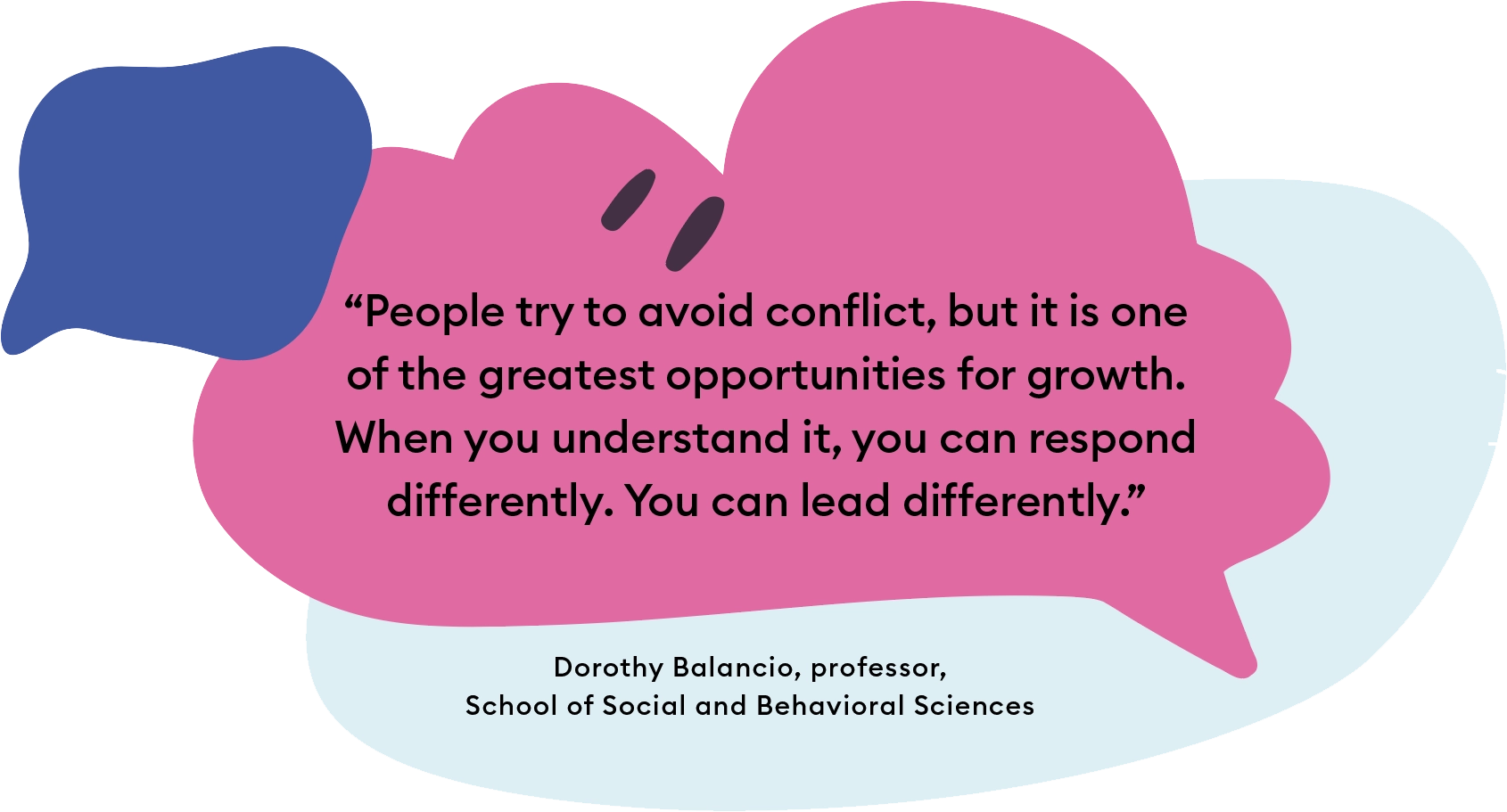
“People try to avoid conflict,” she said. “But it is one of the greatest opportunities for growth. When you understand it, you can respond differently. You can lead differently.” That shift from avoidance to understanding is at the heart of the minor.
As Mercy University marks 75 years of expanding access and opportunity, the Conflict Studies minor
represents a forward-looking investment in what comes next. Graduates will be prepared not only for the workforce, but to navigate it with clarity, empathy and purpose.
Conflict is inevitable. Knowing what to do with it is what sets Mercy students apart.