
Maverick Magazine 2026: Bright Futures Straight Ahead
- News & Events
- News
- Maverick Magazine 2026: Bright Futures Straight Ahead

How Mercy’s Quest is redefining general education.

Bright Futures Straight Ahead
Business education reimagined for the AI age.
Every generation faces new technology that changes the way people work. From the invention of the wheel to the rise of computers, innovation has consistently reshaped the workforce while opening new opportunities for those ready to adapt.
Today, artificial intelligence (AI) represents the next major shift, and Mercy University’s School of Business is preparing students to meet it head-on.
As Mercy celebrates its 75th anniversary with an eye toward the future, the School of Business is redefining its curriculum to embed AI across programs while strengthening the essential human skills that will remain vital in an increasingly automated world.
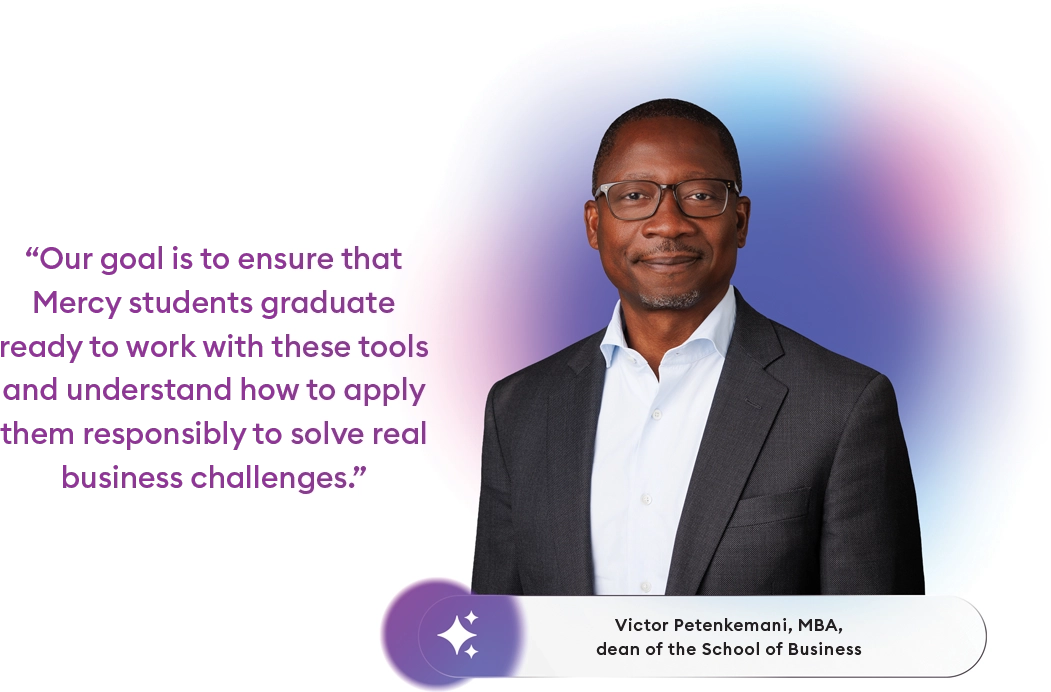
“AI is completely revolutionizing the future of business,” said Victor Petenkemani, MBA, dean of the Mercy University School of Business. “Our goal is to ensure that Mercy students graduate ready to work with these tools and understand how to apply them responsibly to solve real business challenges.”
The need for these skills is growing rapidly. Demand for workers in AI-related or AI-assisted jobs is expected to grow much faster than the 4% average for all occupations between 2023 and 2033, according to the U.S. Department of Labor’s Economics Daily. Jobs for personal financial advisers are expected to grow by 17.1% during that period, even as some of their tasks become automated. Employment in AI-based business solutions software development is projected to grow by 17.9%. Meanwhile, the growing complexity of data infrastructure is expected to drive demand for database administrators and architects, with projected growth of 8.2% and 10.8%, respectively.
Workers with AI skills are already seeing significant financial benefits. According to a 2025 global AI jobs report from PricewaterhouseCoopers, workers with AI skills are earning a 56% wage premium compared with workers in the same roles without those skills. The report also found that every industry surveyed is increasingly integrating AI into its operations.
At Mercy, these trends are shaping how the School of Business prepares students for their careers. The curriculum is being redesigned to integrate AI skills throughout coursework while strengthening analytical thinking, professional communication and ethical decision-making.
“As AI increases the speed and efficiency of work, students need both stronger analytical skills and stronger human skills,” Petenkemani said. “They need to know how to collaborate, communicate and make ethical decisions in environments where AI plays a major role.”
Jennifer Fernandes, associate dean of the School of Business and assistant professor, is helping to lead a faculty initiative to redesign the curriculum. The goal is to graduate students who are confident users of AI while remaining thoughtful, critical decision-makers.
One key component of this effort is a new cornerstone course, Foundations in AI, which will introduce students to different types of artificial intelligence and explore both the possibilities and the ethical challenges the technology presents.
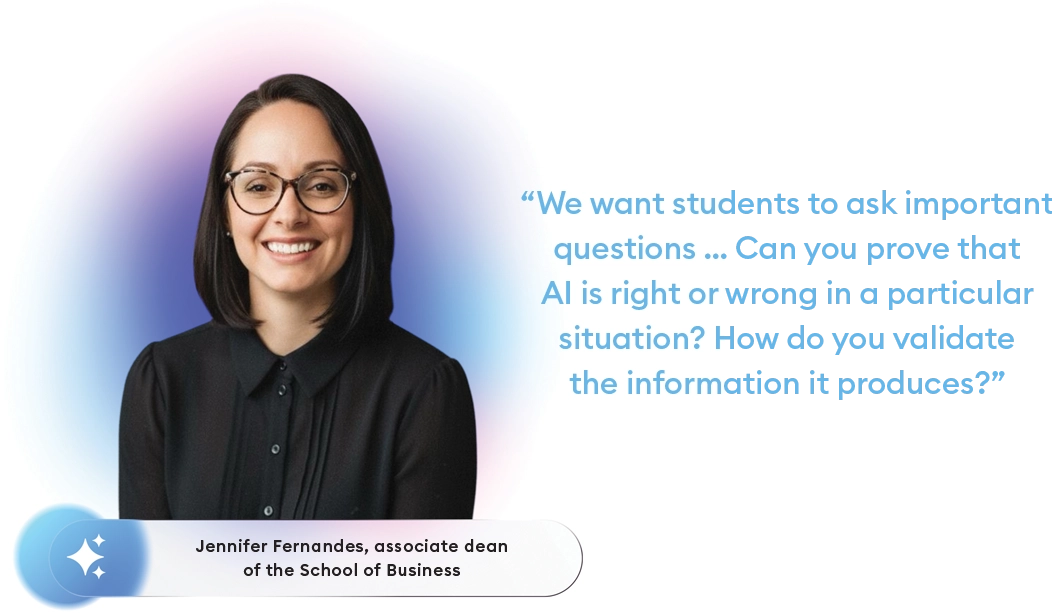
“We want students to ask important questions,” Fernandes said. “For example, can you prove that AI is right or wrong in a particular situation? How do you validate the information it produces?”
Students may also be asked to consider how they would approach a business challenge without relying on AI tools. “A team working on a project might be asked, ‘Given this situation, how would you solve the problem if AI wasn’t available?’” Fernandes said.
The School of Business is also expanding programs and initiatives that align with evolving workforce needs. Mercy recently received state approval for a Bachelor of Science in Risk Management and Insurance, a program designed to prepare students for careers in a rapidly growing field. Many business programs are also incorporating industry-recognized certifications, allowing students to graduate with credentials that employers value.
Hands-on learning remains central to the School of Business experience. Through projects, partnerships and experiential learning opportunities, students gain practical skills that prepare them to contribute in the workplace from their first day on the job.
“These changes are about making sure our students are ready not just for today’s workforce, but for the workforce of the future,” Petenkemani said.
Those efforts build on long-standing strengths of Mercy’s School of Business — innovation, strategic partnerships and global engagement — while positioning students to thrive in a world where technology continues to evolve.
“The work we are doing now is really transforming the curriculum,” Petenkemani said.
And in the age of AI, that transformation is designed to give Mercy students an advantage: the ability to combine advanced technology with the human judgment, creativity and leadership that businesses will always need.