
“Counted Out” Documentary Sparks Discussion About Math, Education and AI
Math is everywhere, not just in the classroom. It’s in the everyday decisions we make, the problems we solve and the way we navigate the world. And as artificial intelligence (AI) transforms education and the workplace, understanding mathematics may be more important than ever.
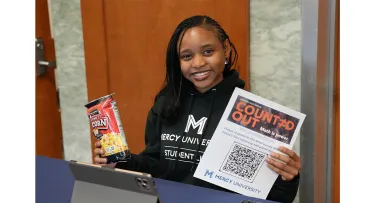
That message took center stage at Mercy University's Westchester Campus on November 13, when students, faculty and staff gathered for a screening of “Counted Out,” a documentary exploring the power of mathematical literacy and the consequences of being excluded from it.
Directed by Vicki Abeles, the film examines how mathematical understanding influences economic opportunity and participation in society. It also challenges some deeply held assumptions about who can learn math and why so many people believe they simply aren't "math people." The film suggests that these beliefs often have less to do with mathematical ability than with how math is taught and experienced, particularly in the classroom.
Those themes carried into a panel discussion following the screening, where Mercy students and faculty shared their own experiences with mathematics, from overcoming math anxiety to preparing the next generation of educators.
For Miguel Lopez Hernandez, a mathematics major and teaching assistant, getting good at math comes down to practice, not innate ability. He described how mental math helps him navigate everyday situations, from calculating percentages to working with fractions and ratios, and credited his mother and grandmother with encouraging him to practice.
"Just because someone is good at math doesn't mean that their brain is constructed differently," he said. "Everybody that is good at something was once bad at it, myself included."
Fellow student Yanet (Sophie) Guerrero, a Suzanne McGraw Scholar in the School of Education, revealed that mathematics was once her least favorite subject, but she now helps classmates in college algebra and hopes to inspire the same confidence in her future students.
"I am very proud of myself and the progress that I've made, and I can't wait to expand my knowledge and teach other students," Guerrero said.
The conversation also turned to AI and what its growing influence means for independent reasoning skills.
Dr. Cheng (Jeff) Chang, associate professor of Mathematics and chair of Mercy's Department of Mathematics and Computer Sciences, encourages students to embrace AI without letting it do the thinking for them. He compared AI's emergence to the invention of the calculator, which changed how people perform calculations without eliminating the need for mathematical understanding.
"We need to be the critics of the AI's work," Chang said, emphasizing that mathematical reasoning helps people evaluate information and make informed decisions.
Student panelist Alejandra Cambillo Guerra, a mathematics major and computer science minor who hopes to become a high school math teacher, agreed with Chang’s perspective.
"AI will produce an answer, but it can't understand why it got that answer," she said. "And it's up to students to understand why and how you can get to that answer while using AI as a tool to help you."
Dr. William Farber, associate professor of Mathematics Education, described how he approaches this challenge in a course he designed at Mercy, Mathematical Problem Solving. Rather than simply finding the right answer, students explore strategies such as working backward, identifying patterns and developing alternative solutions.
"You can't take the place of thinking," Farber said.
The discussion also highlighted the role teachers play in shaping students' relationships with mathematics. Several panelists recalled educators who either deepened their anxiety or helped them discover what they were capable of.
Cambillo Guerra, who once struggled with math herself, remembered the teachers who made a difference by taking the time to explain concepts in ways she could understand. It's an approach she hopes to bring to her own classroom someday. "Students should be able to learn in the ways that they learn best," she said.
The screening and discussion reinforced Mercy's commitment to helping students build confidence in their mathematical abilities, think critically and develop problem-solving skills that will serve them throughout their lives.