
A Day in the Student Seat: Mercy Faculty Learn from Each Other at Faculty Seminar Day
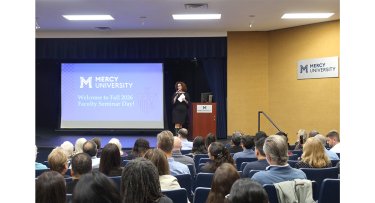
On October 7, Mercy University faculty came together for Fall Faculty Seminar Day, a day of collaboration and knowledge-sharing.
Hosted by Mercy's Center for Teaching and Learning and Teaching and Learning Advisory
Committee, Faculty Seminar Day takes place twice a year. On those days, professors step away from the front of the room and take the student seat.
This fall's program offered 14 seminars, covering everything from AI in the classroom to accessible course design.
Mercy President Susan L. Parish, Ph.D., M.S.W., opened the day by reminding faculty how rare a full day of learning can feel.
"In the midst of our incredibly high-speed lives, this is a luxury," she said. "I hope that you will come away from today feeling invigorated and energized."
Earlier this year at Faculty and Staff Convocation, Provost Kristin Curry Greenwood called on the whole University to commit to a year of learning. That call applies to faculty and staff as much as it does to students. Faculty Seminar Day puts it into practice.
Provost Greenwood describes herself as a back-row learner. From the last row, she said, you see everything happening in the classroom. She sees a clear line between what faculty learn on a day like this and what students take with them after graduation.
"The more we develop our faculty, the better our students are prepared for the real world," she said. "It also brings together community, because we're all here to learn."
Faculty Senate President Denise Stefano asked her colleagues to embrace the role reversal.
"Today we are the learners," she said. "We sit in the student seat, and we look to our faculty colleagues leading sessions to showcase their expertise."
She also issued a challenge. Faculty tend to drift toward sessions in their own field, often to support a colleague who's presenting. Stefano encouraged everyone to pick at least one session far outside their own field. A nursing professor might learn something from a business session, and a liberal arts professor might find a new idea in a science session.
"Break out of your silos," she said. "Keep yourself open."
For Professor Robert Bohn in the School of Business, the reason to show up is simple.
"I love the fact that I teach at a school that actually wants to know how I feel, and will do something about it," he said. "So, I love it here."
Inside the Breakout Sessions
After the opening remarks, faculty split up for sessions led by their own colleagues. Here's a look at five of them, starting with a program that has changed the odds for students in Mercy's toughest science courses.
Peer Leaders Help More Students Pass Gateway Science Courses
“From Supplemental Instruction to Structured Learning Assistance: A Decade of Peer-Led Learning Support in Gateway Science Courses at Mercy University”
Facilitated by Dr. Anthony Canger, Dr. Lisa Sarran-Armogan and Dr. Lee Warren, School of Health and Natural Sciences
Introductory chemistry and biology courses challenge students at colleges across the country. Nationally, about 32% of students in these courses earn a D or F or withdraw (DFW rate).
Mercy's answer is Structured Learning Assistance (SLA), a peer-led model built around a required recitation. Three faculty members walked colleagues through a decade of results.
In General Biology, the share of students earning a D or F or withdrawing fell from 43.6% in the first four semesters tracked to 17.5% in the four most recent semesters. The rate has stayed below the national benchmark every semester since fall 2019.
Here's how it works: Recitation meets right after lecture. When the instructor leaves, two peer leaders step in to run problem-solving sessions, worksheet practice and exam reviews. Recitation counts for 10% of the course grade.
The peer leaders know the course well because they've taken it and excelled in it.
"These peer leaders were among some of our best students," said Sarran-Armogan. "These are students who did well in the course prior, and they can provide that feedback to the students who are in their groups."
Faculty stay closely involved. Instructors talk with peer leaders regularly about which topics to reinforce, and the team now provides standardized worksheets and video support to every section.
"The students and peer leaders are not on their own," said Warren. "We're taking an active role in terms of pedagogy and the types of problems the students are working in those recitations."
The team is now looking at how math preparation shapes success in chemistry, and how the SLA model could expand to other courses and disciplines.
"I'm always trying to improve everything," said Canger, who joined the program more recently. "Aren't we all?"
Every Student Brings a Story
“Every Student has an Origin Story: Using the Hero's Journey to Foster Belonging, Resilience and Student Success”
Facilitated by Professor Lisette Hughes, School of Social & Behavioral Sciences
Every student walks into class with an origin story. Their identities, experiences, strengths, relationships and goals shape how they see themselves in college.
Professor Hughes built her session around the Hero's Journey, the story structure made famous by Joseph Campbell. Her first-year seminar inspired the idea, and she draws on the I, Hero workbook, created by a New York City nonprofit, which helps people focus on their strengths and the future they hope to build.
The twist is who plays the hero. Hughes asked faculty to see students in that role, with faculty serving as guides.
"We can look at the student as a superhero," she said. "Then we are just part of that hero's team."
A professor can offer an observation, some advice or a resource. The student decides which path to take. Hughes had participants work through the same reflection prompts they can use with their own students, so they could feel how the exercise lands before bringing it to class.
AI as a Learning Tool, not a Shortcut
“Practical Strategies with AI Integration in the Classroom: Examples Using Boodlebox”
Facilitated by Dr. Naushad Kollikkathara, School of Business, and Dr. Damien Germino, Office of Information Technology
Mercy faculty and students use Boodlebox, an AI platform built for higher education. Dr. Kollikkathara and Dr. Germino showed how faculty can use it to support learning instead of replacing it.
Kollikkathara urged faculty to begin with the learning outcome before they build an AI assignment or bot.
"Start with trying to understand the goal," he said. "What do you want students to take away? What is the learning outcome here? That is your North Star."
Germino teaches AI Essentials: A Practical Approach. His students work in teams all semester, as if a company hired them. They use Boodlebox to brainstorm survey questions, build surveys and analyze the responses.
On the first day, Germino teaches students about AI hallucinations and why they need to fact-check what a chatbot tells them. Because the chats are time-stamped and saved, he can see how students reached their final work, not just the result.
For faculty who want to try this, Mercy provides a syllabus statement template and a responsible-use video.
Learning that Lasts Past the Final Exam
“Transformative Teaching: Deep Learning Strategies to Prepare Tomorrow's Professionals”
Facilitated by Dr. Carolyn Cullen and Dr. Jack Simons, School of Social & Behavioral Sciences
Counselor educators Dr. Cullen and Dr. Simons drew a line between two kinds of students. One wants to know exactly what the professor wants and how to earn the A. The other gets curious, takes risks and keeps what they learn long after the semester ends.
Drawing on the work of education scholar Ken Bain, they argued that deep learning changes how students think and act. It also prepares them for jobs that call for critical thinking and teamwork, not memorization.
Cullen once asked a student why she signed up for an internship seminar. The answer: "I had to."
"We're trying to encourage intrinsic motivation," Cullen said, "really making students excited about learning, helping them figure out what they already know and what they don't know."
That means giving students room to fail and making it clear that failing is OK. Simons shares how he grades up front so students don't get lost chasing points. He rereads drafts, meets with students more often and treats the syllabus as a living document.
He also pays close attention to the quieter students in the room.
"We want to make sure that we're drawing out all students," Simons said, "and we're thinking about how each student thinks differently."
Designing Courses with Every Student in Mind
“Accessible Course Design”
Facilitated by Dr. Rachel Roy, School of Liberal Arts
About one in five undergraduates reported having a disability in 2019-2020, according to the National Center for Education Statistics. Dr. Roy pointed out that the real number is likely higher, as many students never pursue official accommodations, and some don't have a diagnosis.
Accommodations remain an important legal protection. Roy shared that faculty can do more by building access into a course from the start, an approach known as Universal Design for Learning.
"Access is something we should be working on collectively in the classroom," she said. "Both instructors and students can work toward more access."
She shared changes any professor can make this semester:
- Use a 12- to 14-point sans serif font and left-aligned text
- Choose bold over italics for emphasis
- Swap cold phrasing for warm phrasing (Class participation is required vs. I hope you’ll actively participate)
- Use the term "course values" instead of "course policies"
- Add an "About the Instructor" section to the syllabus
- Offer students more than one way to participate, complete assignments and get in touch
Roy also described "access fatigue," the exhaustion students feel when they have to negotiate their needs with every professor, every semester. A welcoming syllabus can save them some of that work.
Back to the Classroom
By the end of the day, faculty had traded strategies across schools and disciplines. Science professors presented alongside counselor educators, and IT staff alongside business faculty.
The real test comes when those ideas reach Mercy students.
Provost Greenwood sent faculty off with a simple charge: "Take that learning and that great feeling back to your classrooms."
The next Faculty Seminar Day takes place in the spring.