
AdAge: How higher education marketers can win students with new creative approaches and media strategies
Mercy University's Associate Vice President for Marketing and Communications Chris Connelly was interviewed and featured by AdAge in an article about creative approaches and strategies for higher education marketing.
Read the article here and below
How higher education marketers can win students with new creative approaches and media strategies
April 07, 2026
The University of North Carolina late last year unveiled a campaign touting its aim to be first across everything, including academics and athletics, and outlining how it benefits the state overall. This pivot from the typical higher education ads showing students strolling perfectly landscaped campuses isn’t an anomaly. It’s part of a trend as colleges and universities rethink how they’re advertising to donors, alumni and especially prospective students.
This fresh approach is carrying through to website overhauls, media choices and branding messages that speak to more than just academics. The shift comes as soon-to-be high school graduates question the value of a higher education degree and the industry faces a “demographic cliff” that projects a steady decline in college-aged students due to Americans having fewer babies since the Great Recession of 2007-2009. Some schools also face unwanted attention due to political scrutiny of policies perceived as progressive by the Trump administration.
“The cost of higher education has soared. It’s getting harder and harder for people to justify the cost and so you’ve got this value skepticism. There are a lot of people founding tech companies right out of high school. People are going to trade schools,” said Ken Pasternak, chief strategy officer and executive VP of TwoxFour, the ad agency that created the UNC campaign.
“The stakes are getting really, really high,” he said, especially considering the cost.
Most higher education marketers are trying to convince students to spend four years of their lives and $38,270 a year on average to attend their universities, said Jessica Vincent, president of independent agency Cornett, which has a long partnership with the University of Kentucky.
It’s not an easy task, as higher ed marketers are working with tighter budgets and complex, risk-averse organizations steeped in layers of bureaucracy. Some universities are finding ways to break through creatively. The guide below explains how to do that, based on interviews with 17 experts.
Lead with culture and identity, not rankings
Mercy University is relying on creativity to carve out a distinct identity in what Chris Connelly, its associate VP of marketing and analytics, calls “a sea of sameness.” The New York-based school undertook a major marketing overhaul in 2023, when it rebranded from Mercy College.
“There’s a very high likelihood of seeing something indistinct in this industry that you could slap any logo on,” said Connelly, who joined from Benjamin Moore & Co.’s marketing team in 2018. “We need to make sure that when somebody sees Mercy University, they know it’s Mercy University.”
Mercy’s rebrand kicked off with an ad that played up its Mavericks mascot. In the spot, created by Familiar Creatures, a college-aged girl finds a wild horse on a side street in Brooklyn. She proceeds to tame and ride the horse, with a voiceover asking: “What makes a Maverick? The world isn’t made for mavericks, but Mercy University is.”
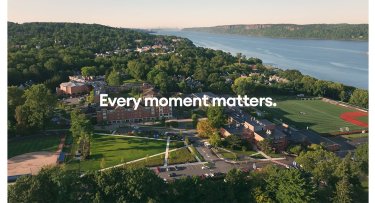
That ad, which was shot in Brooklyn with a horse and trainer from “Game of Thrones,” was directed by Cuba Scott, granddaughter of Ridley Scott, recalled Justin Bajan, co-founder of Familiar Creatures. Mercy University followed that feat with several out-of-the-box campaigns. Its “Every Moment Matters” brand platform focuses on the student’s full journey, including navigating relationships with professors and roommates, Connelly said.
Mighty Union recently rebuilt Massachusetts Bay Community College’s website to cater to the student experience, according to Angela Herbst, the agency’s chief client officer. Herbst said she’s seeing more colleges seeking this type of work. “They really need help tailoring the digital experience to what their unique student audience and target population needs to experience and see from them.”
MassBay’s messaging points out that 94% of its graduates find jobs after graduation. These types of stats are important in higher education recruitment campaigns, as people question the value of college and are fearful that when they graduate, they won’t be able to find a job due to AI, several people interviewed said.
Some online universities are tackling the cost factor in their creative. The American College of Education, for example, promotes “the pure math” of not coming out with a ton of debt, said David Schiff, partner and chief strategy officer of Standard Practice, the agency behind the college’s campaign.
An ad for the school features two characters named Ed with the same types of degrees. One of them, who calls himself Smarter Ed, went to the American College of Education and doesn’t have any student loan debt.
“We’re not saying that normal Ed is dumb Ed,” said Myles Rigg, founding partner, creative at Standard Practice. “It’s just, he went in a different direction without knowing there was this whole other way to get the same quality education.”
Getting around TikTok restrictions
Many colleges are working with creators, which often includes having students show “what life is really like on campus and [get] people excited about it before they join,” said Jessica Romaniuk, president of TwoxFour, where a recently established higher education practice counts Caltech, DePaul, Duke, Harvard, Yale and other universities as clients.
The average higher education marketing budget ranges between $200,000 and $3 million, according to Romaniuk. Plus, several experts said many higher education marketers operate under shrinking budgets.
Organic social on TikTok can be really effective for colleges, Romaniuk said. Ohio’s Bowling Green State has been leaning into a “really amazing” organic social partnership with “Pudge The Cat,” for example, that has gone viral, she said. TwoxFour handles paid social for the college but organic social work is done in-house.
For most marketers, TikTok is a necessity to reach younger consumers. However, the popular social media app is banned on some campuses, sometimes because of state restrictions, mainly due to perceived security concerns over its ownership by a Chinese company—all public universities in states including Florida, Georgia and Texas have active bans. That means college employees can’t manage accounts while on school property. Some restrictions remain in place despite TikTok landing a $14 billion deal in January to establish a U.S. subsidiary.
In states with such bans, public colleges can’t funnel state funds to market on TikTok, according to 11 people interviewed who dealt with these challenges firsthand. There are workarounds. Some colleges with campus bans give full control of their TikTok account to their agency partner, because technically, that is not a college employee having an account, several people said.
David Hunter, co-founder of Hunterblu Media, which works with colleges such as the Darla Moore School of Business at the University of South Carolina, said he once had a higher education client who went to offsite locations including coffee shops to manage an account. He said he’s witnessed several public universities in states with TikTok bans set aside some of the private funding they receive for TikTok marketing.
“It proves to be really tricky,” said Chris Witherspoon, co-founder of DNA&Stone, an agency that works with the University of Washington. “Universities tend to be risk-averse. The last thing you want to do is be in a position where you’re being called out or, worse, having a lawsuit against you. Therefore, doing the work that might stand out a little bit more, you have stricter guardrails.”
Hunter said many colleges are demanding to see exactly which channels are driving actual enrollments, which is very difficult when you’re running awareness campaigns on social media apps. Being able to target specific groups is also tough on TikTok. “The targeting parameters are much more general, so you can’t get as niche with it,” Romaniuk said.
Where to put your budget for real enrollment ROI
YouTube and Snapchat have yielded some of the best returns for colleges, several experts said.
RP3, an independent creative agency that works with several universities, including the University of Maryland, has turned to Snapchat when university clients denied its requests to activate on TikTok, said Beth Johnson, founder and CEO.
And for the past decade, every college that Jaime Hunt has worked at or with has viewed YouTube as “one of the most important channels,” she said, noting “video has just grown in leaps and bounds.” Hunt is the founder and president of Solve Higher Ed Marketing, a consulting firm for colleges and universities, and a fractional marketing and communications lead for Agnes Scott College. She previously led marketing for schools such as Old Dominion University and Miami University.
Hunt, who said she worked with one college with a $300,000 marketing budget, advises schools operating with small budgets to be “a lot more specific with segmentation; really narrow in who is your audience so you can laser target them. We did a lot of research into where they were physically, what channels they use and directed our resources to them.”
Along with prospective students, schools are also trying to reach their parents. Meta and LinkedIn have become good channels to engage with that target, Solve Higher Ed Marketing’s Hunt added.