
Center for Teaching and Learning
Welcome to the Center for Teaching and Learning (CTL)!
Information about our Center, how we support all faculty, and our programming is shared on this site. To view our events for the Fall 2026 semester, you may download the full calendar by clicking the button below, view each month further down on this page, or scroll through upcoming events at the bottom of this page. You may also view our past events for Spring 2026 by clicking the button below and downloading last semester's calendar. Faculty may learn more about and register for upcoming events using information shared via email from CTL or by using your Mercy University credentials to access our CTL Faculty Professional Development Resources Blackboard Organization.

The Center for Teaching and Learning (CTL) promotes teaching excellence for student success in alignment with the Mercy University mission and strategic goals. CTL is dedicated to fostering faculty development and the pursuit of teaching excellence across all disciplines and modalities via programming, faculty-led learning communities, and the development of learning modules on successful teaching practices.
In addition to participating in professional development events, faculty members are welcome to schedule a consultation with a CTL instructional designer at any point in the semester. Topics include syllabus design, student engagement techniques, and inclusive pedagogy.
To schedule a consultation, please reach out via the CTL email: CTL@mercy.edu
Sample Programming and Services Offered Through CTL
Communities of Practice
We host Communities of Practice, gatherings of faculty-proposed and faculty-led sessions about special topics of interest in higher education, with each group typically meeting multiple times per semester. Current Communities of Practice include "Getting Started in AI," "Diversity Dialogues," and "Supporting All Learners."

CTL Workshops
CTL Workshops, including Lunch and Learn sessions that are held in the late morning or early afternoon, as well as other sessions throughout the day, are typically stand-alone workshops or presentations on a particular topic. Recent topics include "Differentiated Assessments," "Curriculum Vitae (CV) Workshop," and "Rubrics and Checklists for Final Assessments."

Faculty Seminar Day
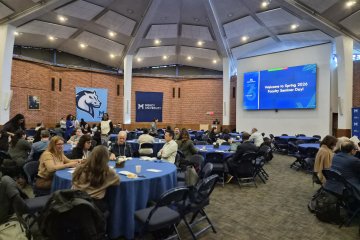
Faculty Seminar Day is a full day each semester dedicated to supporting teaching excellence at Mercy University, and is sponsored by CTL and the Teaching and Learning Advisory Committee (TLAC). The day's events have included an invited Keynote Speaker, as well as multiple breakout sessions where Mercy faculty showcase their evidence-based teaching practices and share their ideas and insights with their colleagues.
Individual Consultations
We offer one-on-one or small group meetings to discuss topics such as classroom best practices, course development and implementation, and new ideas for teaching. These consultations may be done either in-person or online via Zoom. Please reach out to us at CTL@mercy.edu to schedule an appointment.

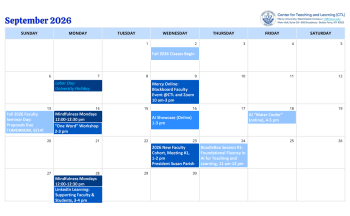
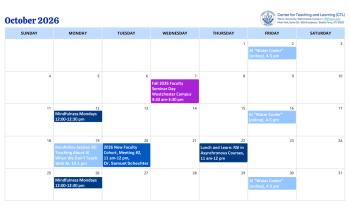
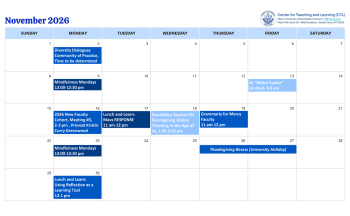
CTL Fall 2026 Events
CTL provides faculty support via events and programming that are grounded in evidence-based practices and that advance our commitment to creating learning environments in which all students can succeed. The majority of our CTL-hosted events are held in a hybrid format, which may be attended either in-person or online.
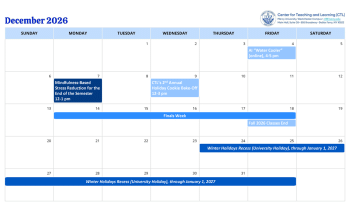
Below are monthly views of the CTL events taking place in Fall 2026. For more information, please click the button at the top of this page to download these calendars as well as session descriptions. Faculty may learn more about and register for these events using information shared via email from CTL or by using your Mercy University credentials to access our CTL Faculty Professional Development Resources Blackboard Organization.


CTL Inclusive Pedagogy Course
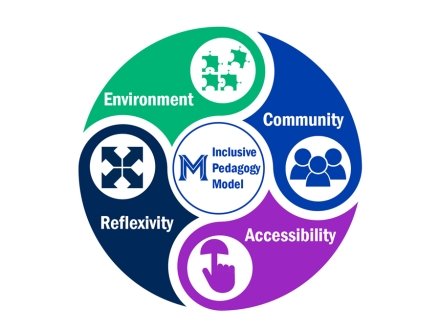
Faculty are invited to explore CTL's self-paced Inclusive Pedagogy course which provides best practices for creating an inclusive teaching and learning environment in which all students can succeed.
This course is comprised of three quick, easy-to-access modules which can be viewed independently or together and which feature the voices of Mercy University community members.
To access this and other CTL self-paced learning modules, log onto the Faculty Development Resources on Blackboard under Organizations.

CTL Teaching and Learning Matters Podcast
The CTL Teaching and Learning Matters podcast features the voices and expertise of Mercy faculty as we explore evidence-informed pedagogical practice and the art of facilitating learning for all students.
Episode 1 featuring Saliha Bava, PhD, SSBS: What does it mean to teach inclusively?
Episode 2 featuring Susan Moscou, PhD, SHNS and Allison Murphy, PhD, SHNS: Radical Pedagogy
Episode 3 featuring Victor Petenkemani, MBA, SBUS: Teaching for Success
Episode 4 featuring Lisa Martin, PhD, SHNS, Rossi Hassad, PhD, SSBS, Mary Lozina, Director, Online Learning: Distance Learning Best Practices and Alignment with Regulation
If you have ideas for future episodes, please email CTL@mercy.edu.


Scholarship of Teaching and Learning (SoTL)
The Center for Teaching and Learning at Mercy University embraces the Boyer Model of the Scholarship of Teaching and Learning (SoTL). We are proud to support faculty and staff members with their contributions to this critical and growing field that supports student success.
The resources below further define SoTL and are meant as a guide to direct faculty to publications and conferences relevant to the Scholarship of Teaching and Learning. If you would like to add a resource to this dynamic list, please email CTL@mercy.edu.
In the 1990s, Ernest L. Boyer, the former Chancellor of the State University of New York who also served as United States Commissioner of Education and as President of the Carnegie Foundation for the Advancement of Teaching, developed a categorization of scholarship that faithfully guides the Academy to this day.
Mercy University and the Center for Teaching and Learning embrace the Boyer model, acknowledging the value of all four categories of scholarship and the dynamic inter-relationship that exists among the intellectual pathways and functions of: Discovery, Integration, Engagement (Application), and Teaching and Learning.
SoTL has flourished into a vibrant international movement with affiliated professional societies to nurture and grow research and reflection using cross-disciplinary methodologies.
News and Journals
The Chronicle of Higher Education
The Journal of Higher Education
Books
How Learning Works: Seven Research-Based Principles for Smart Teaching (Ambrose et al., 2010)
What the Best College Teachers Do (Bain, 2004)
Small Teaching: Everyday Lessons from the Science of Learning (Lang, 2016)
Center for Teaching and Learning Staff
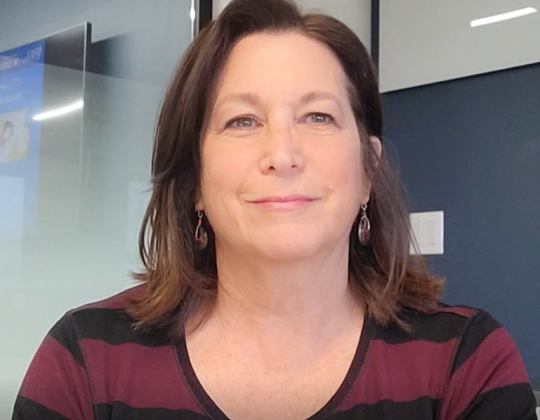
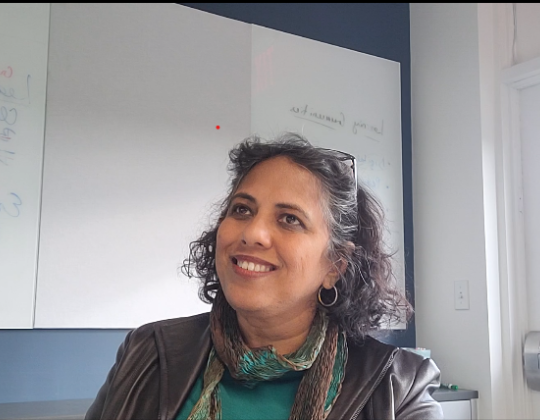
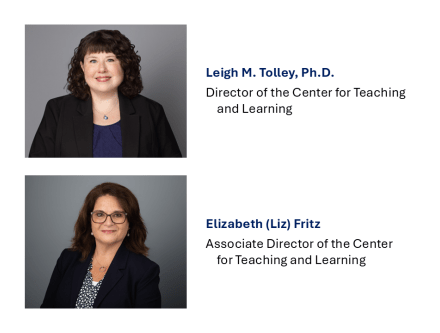
Our Center for Teaching and Learning (CTL) staff advance CTL’s mission of promoting excellence in teaching and learning across the University. We support faculty development through initiatives that foster instructional innovation, inclusive pedagogy, evidence-based teaching practices, and continuous professional growth. By working collaboratively with faculty, academic leadership, and departments, we guide the Center’s strategic vision in alignment with Mercy’s mission and institutional priorities.
Dr. Tolley brings over two decades of experience as an educator, instructional designer, mentor, and researcher, most recently serving as a tenured Associate Professor of Secondary Education in the College of Education & Human Development at the University of Louisiana at Lafayette (UL Lafayette). She has extensive experience in instructional design and evaluation, faculty and mentor teacher training, and in cultivating reflective, inclusive teaching practices. She also served as the co-creator, Program Co-Coordinator, learning management system administrator, and Instructional Designer for the UL Lafayette Mentor Teacher Training Program, where she oversaw its initial seven cohorts that led to over 200 successful program completers.
A passionate advocate for faculty mentorship and interdisciplinary collaboration, Dr. Tolley has led initiatives in classroom assessment, teacher preparation, course redesign, educator training, accreditation, and formative evaluation. Her leadership in faculty development includes national presentations and publications, as well as contributions to professional organizations such as the American Evaluation Association and the American Educational Research Association.
Dr. Tolley earned her Ph.D. and M.S. in Instructional Design, Development and Evaluation from Syracuse University, an M.S.Ed. in Secondary Education from the University of Pennsylvania, and a B.A. in English from the University of Pennsylvania.
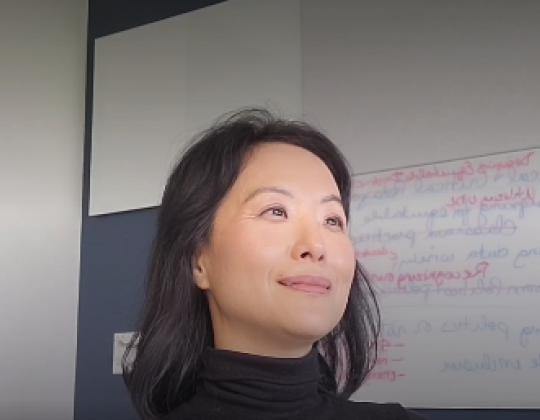
Since joining CTL as an Instructional Designer in September 2022, Liz has made an extraordinary impact through her leadership, initiative, and unwavering commitment to faculty and student success. She has organized and facilitated Faculty Seminar Days, Communities of Practice, and Lunch and Learn workshops; supported faculty through individualized consultations and instructional materials reviews; and developed online learning modules and presentations on inclusive teaching, adult learning, effective syllabus design, and online instruction. Her work has been marked by thoughtfulness, collaboration, and excellence.
With more than 20 years of teaching experience, Liz brings deep pedagogical expertise and a strong student-centered perspective to her work. Prior to joining CTL, she served as Learning Support Manager for the Center for Academic Excellence and Innovation (CAEI), where she supported and strengthened the pedagogical practices of writing tutors. In addition to her work in CTL, Liz teaches as an adjunct faculty member in the Department of Literature and Language, trains English Learning Assistants (ELAs) for first-year writing courses, and teaches in the Aim to Graduate (AIM2G) Program, helping students stay on track toward graduation.
Liz earned an M.A. in English from Long Island University, an M.S. in Organizational Leadership from Mercy College, and a MicroMasters in Instructional Design and Technology from the University of Maryland Global Campus.
Upcoming CTL Events (from Mercy's News & Events calendar)
Faculty may learn more about and register for these events using information shared via email from CTL or by using your Mercy University credentials to access our CTL Faculty Professional Development Resources Blackboard Organization.



BoodleBox Session #3: Reimagining Online Teaching in the Age of AI (hybrid event)
- November 18, 2026 1:00 - 2:30 PM
- Online
- Westchester
Mindfulness-Based Stress Reduction for the End of the Semester (hybrid event)
- December 7, 2026 12:00 - 1:00 PM
- Online
- Westchester