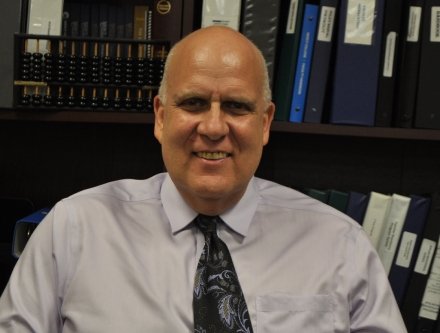
Dr. Farber’s path to higher education began in the Bronx, N.Y., where his passion for mathematics was sparked by a dedicated middle school teacher who encouraged him to join the school’s competitive math team. Early experiences helping at his father’s fruit and vegetable stand taught him the everyday applications of math, from measurement and estimation to managing currency and connecting with people. Those formative lessons shaped both his problem-solving mindset and his approach to teaching.
After six years of service in the United States Navy during the Vietnam War, Dr. Farber pursued his B.S. in Mathematics from Manhattan College, followed by an M.A., M.S., and Ed.D. in Mathematics Education from Columbia University’s Teachers College. His career spans classroom teaching, citywide training and research, all rooted in helping others discover the power and relevance of mathematics.
At Mercy University, Dr. Farber authored and led a $1.16 million National Science Foundation (NSF) Teacher Scholarship Program grant — the Mathematics Education Intensive Residency Program (MEIRPro). Designed to help U.S. military veterans retrain as secondary mathematics teachers, the program has prepared graduates to make a meaningful difference in high-need school districts across the region.
In this Q&A, Dr. Farber reflects on how his early influences and military service shaped his path, shares what he values most about the Mercy community, and offers advice for students beginning their own educational journey.
Q&A
What does working at Mercy mean to you?
Working at Mercy University means being a member of a cohesive community of dedicated educators and having the opportunity to positively impact students' lives everyday through interactive and meaningful educational activities.
What’s the most rewarding or most challenging part of your role that most people don’t realize?
One of the most rewarding parts of my role was the grant award that Mercy University received of just over $1.16 million from the National Science Foundation (NSF) Teacher Scholarship Program. I authored the grant and was the principal investigator of the project, entitled Mathematics Education Intensive Residency Program (MEIRPro). This project was designed to advance mathematics education with a particular emphasis on United States military veterans retraining for new careers as secondary mathematics teachers. The funding from the National Science Foundation was earmarked for three cohorts of veterans to complete a Master of Science degree in mathematics education, most of whom are teaching mathematics in high-needs school districts.
What accomplishment are you most proud of in your professional career?
I am most proud of being inducted into the New York State Mathematics Educators
Hall of Fame, which is sanctioned by the New York State Association of Mathematics Supervisors (NYSAMS).
What upcoming projects, research or initiatives are you excited about?
I will be conducting professional development presentations during the 2025-2026 academic year for teachers, students and supervisors at the following four major mathematics and STEM conferences in the tri-state area:
- Mercy University – Center for STEM Education – “For the Love of STEM”
- Association of Teachers of Mathematics for New York City (ATMNYC)
- The Long Island Mathematics Association Conference (LIMACON)
- The Ten County Mathematics Educators Association Conference (TCMEA)
Share a favorite Mercy University memory.
My favorite Mercy University memory was when Westchester County Executive, George Latimer presented me with a Community Service Proclamation Award to Mercy University for Exemplary Service to Military Veterans.
What’s the most important piece of advice you’d give to a freshman student about to begin their first day at Mercy University?
University life can be challenging, so first and foremost take care of your physical and mental well-being. Second, take advantage of the extensive range of academic support that Mercy University provides through its Center for Academic Excellence and Innovation (CAEI). My third piece of advice is to get involved with the University community by participating in one of the many extracurricular activities that Mercy University has to offer.
What topic could you give a 20-minute presentation on, with no preparation whatsoever?
To honor our student veterans and active-duty service members, my 20-minute presentation would be entitled, Education is Freedom. I strongly believe that education is the key to success and will provide our student veterans a gateway to a purposeful life in a deserving community.
If you were to pursue a different career path outside of education, which field could you see yourself working in, and why?
Due to my love of music, I would pursue a career as a guitarist, singer-songwriter and producer.
Looking ahead, whether in your personal life, academics, or career, what are you most looking forward to and why?
I am looking forward to taking summer vacation with my family. There is nothing better than spending quality time with loved ones.